The AI agent marketplace has evolved from experimental playgrounds into critical enterprise infrastructure. With 40% of enterprise apps expected to feature task-specific AI agents by the end of 2026, organizations face a fundamental decision: how to participate in this ecosystem while maintaining security, compliance, and operational control. The challenge extends beyond selecting the right marketplace to governing how agents access enterprise data and tools. MintMCP's MCP Gateway governs data and tool connections through centralized authentication, tool-level access control, and audit logging, while its Agent Gateway builds on that foundation with agent identities, permissions, memory, and monitoring.
This article maps the 2026 marketplace landscape, covering platform categories, pricing models, governance requirements, and implementation strategies for enterprises evaluating agent marketplace participation.
Key Takeaways
- Enterprise adoption is accelerating, but governance maturity still lags scaled agent deployment
- Vertical-focused agents can concentrate marketplace value by addressing domain-specific workflows, data, and integration requirements
- Outcome-based pricing can align fees with delivered results, but its suitability depends on how clearly those results can be measured and attributed
- A practical governance model can combine agent behavioral controls, data governance, and tool/integration controls through protocols like MCP
- Shadow AI detection has emerged as a critical gap, with most governance solutions providing visibility only for traffic routed through their gateways
- Governed AI agent deployments can reduce setup and credential-management overhead while improving auditability and operational control
What Are AI Agents and Why Are Marketplaces Essential?
AI agents differ from traditional chatbots and automation tools in three fundamental ways: they maintain context across interactions, make autonomous decisions within defined boundaries, and execute multi-step workflows by calling external tools. Where a chatbot answers questions and RPA follows rigid scripts, an agent analyzes a situation, determines the appropriate action, and executes it using available resources.
The marketplace need emerges from three pressures:
- Discovery complexity: Large and rapidly changing catalogs make it difficult to find purpose-built agents without centralized curation
- Integration overhead: Each agent-to-tool connection requires authentication, credential management, and access policy, which creates engineering burden that scales poorly
- Trust verification: Enterprises need mechanisms to evaluate agent capabilities, security posture, and compliance status before deployment
Marketplaces solve discovery and distribution. But the harder problem, governing what agents can access once deployed, requires infrastructure that most marketplaces do not provide natively.
How Agent Marketplaces Are Structured
The 2026 landscape includes four distinct marketplace categories, each serving different buyer needs:
Developer Platforms
These marketplaces prioritize reach and ease of publishing. OpenAI's GPT Store distributes custom GPTs inside ChatGPT, while Poe supports creator monetization through per-message earnings and other program terms. Best for: individual developers and small teams testing market demand.
Enterprise Platforms
AWS Marketplace, Salesforce AgentExchange, and ServiceNow AI Marketplace serve organizations requiring native integration with existing enterprise systems. Pricing and partner economics vary by platform and listing type. These marketplaces provide native ecosystem integration but are naturally tied to their host platforms.
Standalone Marketplaces
Platforms like UpAgents focus on browse-and-hire agent deployment with pay-per-task pricing. Enterprises may still require separate identity, policy, logging, and integration controls for production use.
Open Directories
AI Agent Store and similar directories function as discovery layers linking to external payment and deployment systems. They provide exposure but no governance, authentication, or compliance infrastructure.
The Monetization Landscape
Pricing models have evolved beyond simple SaaS subscriptions. Understanding these structures matters for both buyers evaluating costs and teams building agents for marketplace distribution.
Action-based pricing charges for each completed task or unit of usage, such as a processed document, voice minute, or completed workflow.
Agent-based pricing uses a per-agent, per-seat, or flat monthly access fee.
Outcome-based pricing ties fees to a defined result, such as a qualified opportunity, completed review, or verified cost saving.
Hybrid pricing combines a subscription or platform fee with usage-based or outcome-based charges.
Actual rates vary substantially by platform, task complexity, service level, and contract volume. Buyers should compare current platform rate cards and negotiated enterprise terms rather than relying on generalized market ranges.
Why Enterprise Governance Remains the Critical Gap
Despite marketplace proliferation, Forrester reports that governance gaps persist at more than half of enterprises even after adopting the NIST AI Risk Management Framework, while only a small minority have scaled agentic AI beyond limited production use. This creates significant risk exposure.
The governance gap manifests in three areas:
Agent Behavioral Controls
Forrester's AEGIS framework covers six security domains: governance, risk, and compliance; identity and access management; data security and privacy; application security; threat management; and Zero Trust architecture. It addresses agent identity, permissions, data protection, and behavior across the agent lifecycle.
Data Quality Controls
Atlan proposes a two-layer model that distinguishes agent-layer controls from data-layer controls such as certification, lineage, semantic disambiguation, and access policy. This is one possible governance model rather than a universal industry standard.
Tool and Integration Governance
This third layer, often missing from current frameworks, governs how agents connect to external systems. The Model Context Protocol (MCP) has emerged as the standardization mechanism, but MCP alone does not provide organization-wide policy enforcement, centralized audit logging, or cross-server access governance. An MCP Gateway can centralize these controls.
MintMCP's MCP Gateway uses Virtual MCP Bundles to package tool access, policy enforcement, and audit logging for teams and roles. Its Agent Gateway extends the same governed foundation with per-agent identities, scoped credentials, memory, and monitoring, allowing agent credentials to be rotated or revoked independently.
The Model Context Protocol's Role in Marketplace Infrastructure
MCP has become a widely adopted open standard for agent-to-tool integration. Anthropic reported more than 97 million monthly downloads across the Python and TypeScript SDKs when MCP was donated to the Linux Foundation's Agentic AI Foundation in December 2025. MCP has been adopted by products including Claude, ChatGPT, Cursor, Gemini, Microsoft Copilot, and Visual Studio Code.
What MCP provides:
- Standardized message format (JSON-RPC 2.0 over UTF-8)
- Transport flexibility through stdio and Streamable HTTP; the legacy HTTP+SSE transport is deprecated
- Tool discovery and capability negotiation
- Consistent interface across agent platforms
What MCP does not provide by itself:
- Organization-wide role and tool policy
- Centralized audit logging and compliance evidence
- Credential brokering and rotation across downstream systems
- Cross-server governance and operational controls
MCP includes an optional OAuth-based authorization framework for HTTP transports, but enterprises still need infrastructure to implement organization-wide identity, policy, logging, and credential lifecycle controls.
This gap explains why enterprises need MCP Gateway infrastructure on top of the protocol. The gateway centralizes OAuth brokering, tool-level permissions, request logging, and enterprise policy enforcement while MCP provides the interoperability and transport framework.
For teams building custom MCP integrations, the MCP security whitepaper provides detailed implementation guidance covering authentication patterns, audit requirements, and deployment architectures.
Detecting and Managing Shadow AI Activity
A critical limitation of gateway-only governance: it provides visibility only for traffic routed through the gateway. Agents running locally in developer tools like Cursor or Claude Code can access MCP servers directly, bypassing enterprise controls entirely.
Research indicates this "shadow AI" usage represents a significant portion of enterprise agent activity. Developers naturally prefer direct connections for speed and convenience, creating blind spots in security and compliance programs.
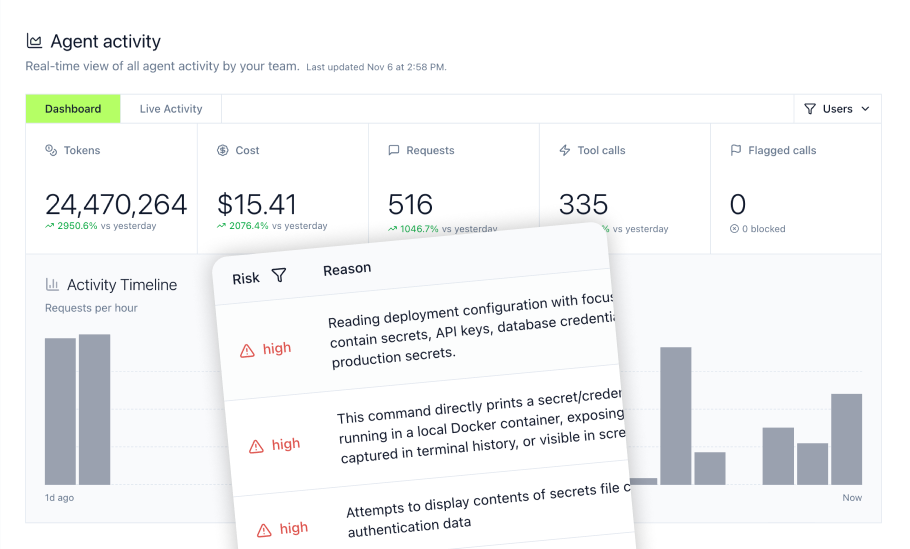
Effective governance requires both gateway controls for sanctioned traffic and detection mechanisms for off-gateway activity. Agent Monitor addresses this through hooks in Cursor and Claude Code that identify MCP usage outside the gateway, detect PII exposure and credential leakage, flag risky bash commands and prompt injection attempts, and support MDM-pushed enforcement for consistent policy application.
The combination of gateway governance and Agent Monitor provides broader visibility across governed MCP traffic and supported local coding-agent activity, including sanctioned and off-gateway use.
Implementation: A Practical Roadmap
Organizations evaluating agent marketplace participation should follow a phased approach:
Phase 1: Assessment (Weeks 1-4)
- Inventory current agent usage across teams (both sanctioned and shadow)
- Map data sources agents need to access
- Document compliance requirements (SOC 2, HIPAA, GDPR applicability)
- Identify integration points with existing identity providers (Okta, Azure AD)
Phase 2: Infrastructure (Weeks 5-8)
- Deploy MCP Gateway with SSO integration
- Configure tool-level access policies by team/role
- Establish audit log export to existing SIEM platforms
- Enable Agent Monitor for developer tool visibility
Phase 3: Controlled Rollout (Weeks 9-12)
- Pilot with 2-3 teams using defined use cases
- Monitor usage patterns and policy violations
- Iterate on access policies based on actual behavior
- Document governance procedures for security review
Phase 4: Scale (Ongoing)
- Expand to additional teams and use cases
- Implement Agent Gateway controls, including Agent Bundles, for autonomous agent deployments
- Enable cross-team tool sharing with appropriate controls
- Build internal MCP server catalog for custom integrations
For detailed implementation guidance, the resources library includes deployment guides, policy templates, and architecture references.
Why MintMCP's Dual-Gateway Architecture Matters
Most marketplace governance discussions conflate two distinct problems: controlling what tools agents can reach and controlling what agents can do once they have access. MintMCP separates these concerns through a dual-layer architecture that addresses both.
The MCP Gateway layer solves the first problem by providing centralized authentication, tool-level access control, credential management, and audit logging for data and tool connections. Virtual MCP Bundles reduce configuration complexity by consolidating multiple connectors behind one governed endpoint. Per-agent identities belong to the Agent Gateway layer, where they reduce shared-account risk and improve audit attribution.
The Agent Gateway layer solves the second problem by providing identities, permissions, memory, and monitoring for the agents themselves. This includes per-agent OAuth credentials that can be rotated independently, scoped memory that follows Git-like principles for versioning and auditability, and monitoring that combines gateway audit logs with Agent Monitor coverage for supported local activity in Cursor and Claude Code.
This two-layer approach matters because marketplace agents operate in a fundamentally different environment than traditional SaaS applications. They make autonomous decisions, hold persistent context, and operate across multiple tools and data sources. A control plane designed for human-mediated workflows cannot adequately govern these characteristics.
MintMCP's practitioner perspective comes from running its own operations on agents, including coworker agents that hold memory, continue work across days, and operate alongside employees in Slack. This operational experience informs product design decisions around memory scope (private, team, org, customer), credential lifecycle, and audit requirements that enterprises need for production agent deployments.
For organizations evaluating agent identities and governance models, the dual-gateway architecture provides a clear separation of concerns: the MCP Gateway governs connections, the Agent Gateway governs behavior, and both integrate with existing enterprise identity, logging, and policy infrastructure.
Frequently Asked Questions
What role does A2A play in agent marketplaces?
A2A enables agents built on different frameworks to communicate, exchange information, and coordinate work. It does not define a payment, metering, or settlement layer. Agent-to-agent commerce therefore requires separate billing, identity, authorization, and settlement systems. A2A has already moved beyond its initial partner announcement, with the Linux Foundation reporting support from more than 150 organizations and enterprise production use during its first year.
What determines whether to publish agents on multiple marketplaces?
Cross-marketplace publishing increases reach but multiplies governance complexity. Each platform has different authentication requirements, policy enforcement mechanisms, and audit capabilities. Organizations should evaluate: discovery value per platform, incremental engineering effort for each integration, consistency of governance controls across platforms, and revenue-sharing terms. Enterprise platforms typically offer higher per-customer value but smaller audiences, while developer platforms offer reach with lower governance guarantees.
How should enterprises approach vertical vs. horizontal agent strategies?
Vertical-focused agents can gain an advantage through domain expertise, tighter workflow integration, and clearer outcome measurement. One practical approach is to start with a defined vertical workflow, then expand into adjacent use cases after establishing product-market fit. This applies both to enterprises building internal agents and to teams publishing agents to marketplaces. Vertical specialization also creates defensible moats through proprietary data and deep process integration that horizontal competitors cannot easily replicate.
What compliance frameworks apply specifically to AI agents?
The EU AI Act classifies AI systems by their intended purpose and use, not simply by whether they are agents. Certain uses in areas such as creditworthiness, employment, essential services, law enforcement, and the administration of justice may be high-risk and subject to obligations including risk management, technical documentation, logging, transparency, and human oversight. NIST's AI Risk Management Framework provides voluntary guidance for managing AI risk across the lifecycle. SOC 2 Type II audited controls can provide assurance for the infrastructure operating agents. HIPAA obligations apply when the relevant organization is a covered entity or business associate and the agent creates, receives, maintains, or transmits protected health information on its behalf, which may require appropriate safeguards and a business associate agreement.
How do marketplace fees compare across platform categories?
Developer platforms typically charge 0-30% of creator revenue, with OpenAI's GPT Store revenue share implementation details still evolving. Enterprise platforms vary significantly by vendor, listing type, and contract structure. Standalone marketplaces range from pay-per-task with no minimums to subscription-based access fees. Open directories generally charge nothing but provide no infrastructure. The total cost of marketplace participation includes platform fees, integration engineering, and ongoing governance overhead, which often exceeds platform fees for enterprise deployments.